
Why Are Carbon Carbon Studs Becoming the Preferred Fastening Solution for Ultra-High-Temperature Applications
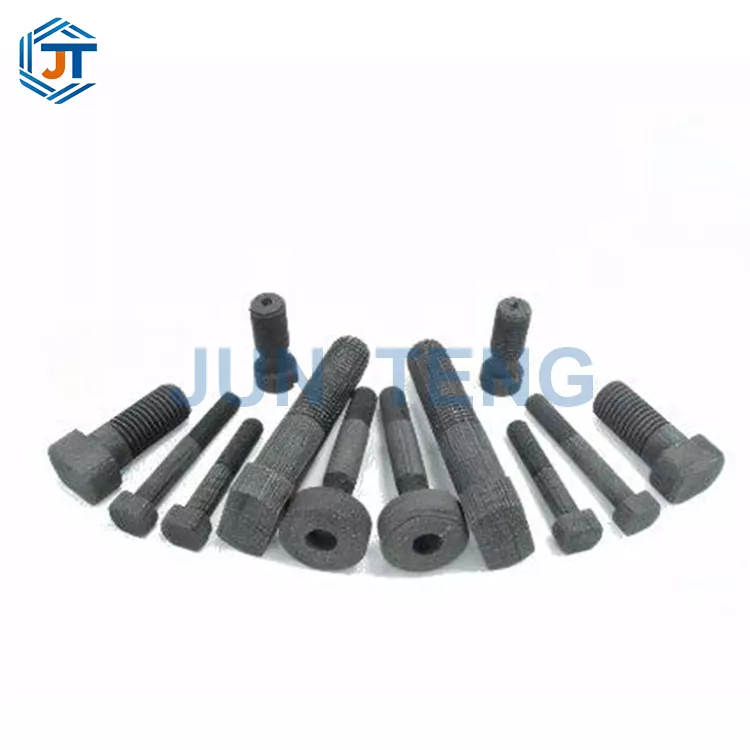
Carbon Carbon Studs are engineered for fastening applications where conventional metal or graphite fasteners struggle with extreme heat, thermal cycling, and contamination control. JUN TENG manufactures carbon-carbon composite studs for photovoltaic furnaces, semiconductor equipment, vacuum heat-treatment systems, and other demanding thermal-field applications, offering precision machining, customized dimensions, and stable performance in inert environments up to 2200°C.
When high-temperature equipment operates under vacuum or inert-gas conditions, the fastening system can directly influence thermal-field stability, component alignment, maintenance frequency, and production reliability. Carbon-carbon composite studs combine a lightweight carbon matrix with continuous carbon-fiber reinforcement, providing a useful alternative to conventional metallic fasteners.
JUN TENG Carbon Carbon Studs are manufactured through 3D carbon-fiber preform weaving, repeated impregnation and carbonization, high-temperature graphitization, and precision CNC machining. Available in M3-M30 thread diameters and 10-600 mm lengths, they can be supplied in full-thread, partial-thread, stepped, and other customized configurations.
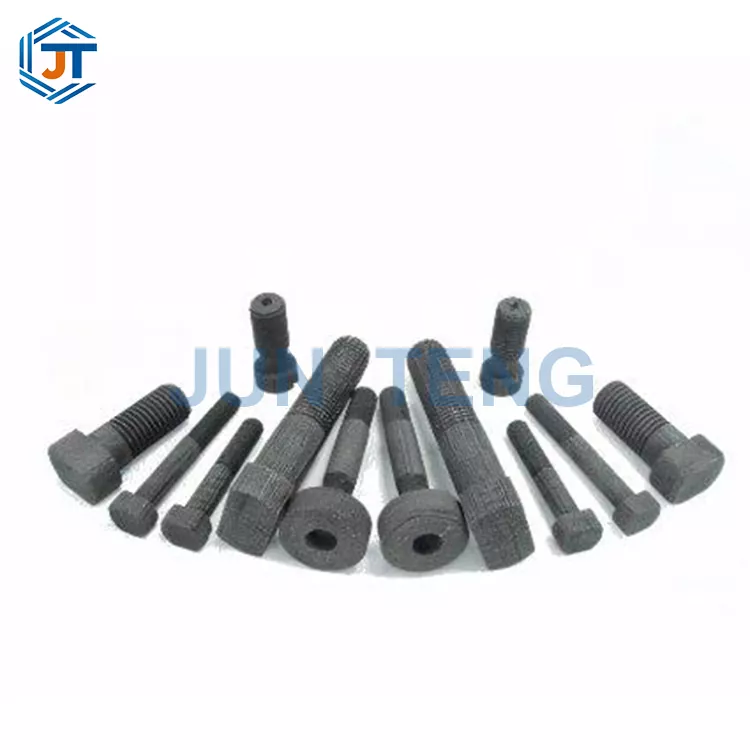
Table of Contents
- What Are Carbon Carbon Studs?
- Why Are They Suitable for High-Temperature Applications?
- What Technical Performance Can Buyers Expect?
- What Are the Main Advantages?
- Where Are Carbon Carbon Studs Used?
- How Are Carbon Carbon Studs Manufactured?
- How Should You Select the Right Stud?
- How Should They Be Installed and Maintained?
- Frequently Asked Questions
- Conclusion
What Are Carbon Carbon Studs?
Carbon Carbon Studs are long-rod fastening components manufactured from carbon-carbon composite material, commonly referred to as C/C composite. Instead of relying on conventional steel, stainless steel, or molybdenum, these fasteners use a carbon-fiber-reinforced carbon matrix to achieve a combination of low weight, thermal stability, and high-temperature performance.
Their structure makes them particularly valuable for equipment in which metal contamination, thermal expansion mismatch, or fastener deformation could affect production quality. A precision-machined thread allows the stud to connect large graphite or carbon-based components securely when paired with compatible nuts and washers.
For buyers evaluating Carbon Carbon Studs from JUN TENG, the key consideration is not simply maximum temperature resistance. Thread integrity, dimensional accuracy, thermal expansion, material purity, thermal shock resistance, and compatibility with the surrounding thermal field are equally important.
Why Are They Suitable for High-Temperature Applications?
Fasteners used inside thermal-processing equipment experience repeated heating and cooling, mechanical loading, and exposure to vacuum or inert gases. Conventional materials may soften, creep, oxidize, or introduce unwanted impurities as temperatures increase.
Carbon-carbon composite studs address several of these challenges. JUN TENG specifies a maximum working temperature of approximately 2200°C in inert environments, while the material's thermal expansion coefficient is closely aligned with graphite and other carbon-based thermal-field components.
This compatibility helps reduce dimensional changes during heating and cooling. Maintaining relatively stable thread engagement can also help minimize loosening and displacement of connected components during repeated thermal cycles.
What Technical Performance Can Buyers Expect?
Material selection should be based on measurable performance rather than temperature claims alone. The following comparison highlights several technical characteristics supplied for JUN TENG Carbon Carbon Studs.
| Test Item | JUN TENG C/C Stud | Molybdenum Stud | High-Temperature Alloy Stud |
|---|---|---|---|
| Bulk Density | 1.64-1.73 g/cm³ | 10.18 g/cm³ | 7.95 g/cm³ |
| Maximum Working Temperature | Up to 2200°C in inert gas | Approx. 1650°C | Up to approx. 880°C |
| Thermal Expansion Coefficient | 0.85-1.35 × 10⁻⁶/K | 5.4 × 10⁻⁶/K | 16.9 × 10⁻⁶/K |
| Ash Content | ≤550 ppm | Heavy-metal precipitation possible | Metal volatilization possible |
| Thermal Shock Resistance | ≥1300 cycles at 1800°C | Approx. 320 cycles before cracking | Rapid softening at high temperature |
| Material Characteristic | Lightweight, non-magnetic, carbon-based | Metallic and heavy | Metallic and oxidation-sensitive |
Actual performance depends on operating atmosphere, temperature profile, mechanical loading, geometry, surface condition, and installation practices. Therefore, engineering evaluation should always consider the complete operating environment.
What Are the Main Advantages?
1. Excellent High-Temperature Stability
Carbon-carbon composite construction can maintain fastening performance at temperatures where many conventional fasteners begin to creep or soften. This makes C/C studs particularly suitable for high-temperature vacuum and inert-atmosphere equipment.
2. Low Thermal Expansion
The relatively low thermal expansion coefficient helps Carbon Carbon Studs work effectively with graphite and carbon-carbon components. Reduced differential expansion can help maintain thread engagement and component positioning during thermal cycling.
3. High Material Purity
For photovoltaic and semiconductor manufacturing, contamination control is critical. A high-purity carbon-based fastening solution can reduce concerns associated with heavy-metal precipitation from metallic fasteners in high-temperature environments.
4. Lightweight Construction
With a reported density of 1.64-1.73 g/cm³, carbon-carbon composite studs are significantly lighter than molybdenum and many conventional metal alternatives. Lower component weight can be useful when designing large thermal-field assemblies.
5. Flexible Customization
- M3-M30 thread diameter options
- 10-600 mm standard length range
- Full-thread and partial-thread configurations
- Stepped and extended designs
- Custom dimensions based on engineering drawings
- Optional SiC anti-oxidation coating for suitable applications
Where Are Carbon Carbon Studs Used?
The combination of thermal stability, low expansion, low density, and high-purity composition makes Carbon Carbon Studs suitable for several industrial applications.
- Photovoltaic manufacturing: Used to connect graphite supports, insulation plates, thermal-field structures, and other components inside crystal-growth and ingot furnaces.
- Semiconductor equipment: Suitable for fastening graphite components inside CVD systems, vacuum diffusion furnaces, and high-purity annealing equipment.
- Vacuum heat treatment: Used in sintering, carbonization, and graphitization furnaces where conventional metal fasteners may experience thermal deformation.
- Aerospace research: Applicable to high-temperature test equipment, thermal simulation systems, and specialized laboratory fixtures.
In demanding thermal-field assemblies, Carbon Carbon Studs are often used together with compatible carbon-carbon washers and carbon-carbon nuts to create a complete high-temperature fastening system.
How Are Carbon Carbon Studs Manufactured?
The manufacturing process directly affects the mechanical and thermal properties of a C/C fastener. JUN TENG uses an integrated production route designed to control the material from preform preparation through final machining.
- 3D Preform Weaving: Continuous carbon fiber is woven into a three-dimensional preform to establish fiber continuity.
- Impregnation: Repeated vacuum and high-pressure impregnation helps fill internal pores and improve the density of the preform.
- Carbonization: Controlled heating converts the matrix into a carbon structure.
- High-Temperature Graphitization: Treatment at temperatures up to approximately 2800°C helps purify and stabilize the material.
- Precision CNC Machining: Five-axis CNC equipment and dedicated diamond tools are used to form accurate thread profiles.
- Inspection and Finishing: Finished studs undergo dimensional and appearance inspection, with optional SiC coating when required by the application.
This integrated process provides better control over material consistency, thread accuracy, and traceability across production batches.
How Should You Select the Right Stud?
Choosing the correct Carbon Carbon Stud requires more than selecting a thread diameter. Buyers should evaluate the complete operating condition before placing an order.
- Operating temperature: Confirm the maximum continuous and peak temperature.
- Atmosphere: Determine whether the application uses vacuum, nitrogen, argon, or another controlled environment.
- Thread specification: Select the correct diameter, pitch, and thread configuration.
- Overall length: Consider component thickness, engagement depth, washers, nuts, and required clearance.
- Thermal cycling: Evaluate how frequently the equipment moves between low and high temperatures.
- Purity requirements: Semiconductor and photovoltaic applications may require strict control of ash and metallic impurities.
- Oxidation protection: For appropriate high-temperature applications involving oxygen, discuss SiC coating requirements with the manufacturer.
How Should They Be Installed and Maintained?
Although carbon-carbon composite materials offer excellent high-temperature properties, they should be handled carefully because the material can be brittle compared with ductile metals.
- Clean the threads and remove dust or foreign particles before installation.
- Use a suitable high-purity graphite lubricant when recommended for the application.
- Apply torque gradually and evenly with an appropriate torque wrench.
- Avoid pneumatic impact tools that can create excessive localized loading.
- For multiple fastening points, tighten components symmetrically to distribute the load.
- Store unused studs in a dry and ventilated environment.
- Inspect threads before reuse, particularly after repeated assembly and disassembly.
Uncoated carbon-carbon components are generally intended for controlled inert or vacuum environments. For oxygen-containing high-temperature conditions, application-specific oxidation protection should be evaluated with the supplier.
Frequently Asked Questions About Carbon Carbon Studs
Q1: What is the difference between Carbon Carbon Studs and graphite studs?
Carbon-carbon studs use a carbon-fiber-reinforced composite structure, while conventional graphite studs are generally made from bulk graphite. The reinforced structure can provide improved strength, thermal shock resistance, and durability for demanding fastening applications.
Q2: What sizes can JUN TENG Carbon Carbon Studs provide?
JUN TENG provides thread diameters from M3 to M30 and lengths from 10 mm to 600 mm, with full-thread, partial-thread, stepped, and customized configurations available according to application requirements.
Q3: Can Carbon Carbon Studs be customized?
Yes. Custom dimensions, thread configurations, lengths, stepped designs, and other special geometries can be manufactured according to engineering drawings and application requirements.
Q4: Can these studs be used with nuts and washers from other suppliers?
Separate procurement is possible, but using compatible carbon-carbon nuts and washers with coordinated thread tolerances can improve assembly compatibility and overall fastening stability.
Q5: Can Carbon Carbon Studs be used in air at high temperatures?
Uncoated C/C studs are primarily intended for vacuum and inert environments. If the application involves high-temperature oxidation conditions, an appropriate anti-oxidation coating and operating strategy should be evaluated with the manufacturer.
Conclusion
As thermal-processing equipment becomes more demanding, fastening components must provide more than basic mechanical connection. Carbon Carbon Studs offer a combination of high-temperature stability, low thermal expansion, lightweight construction, high purity, thermal shock resistance, and flexible customization that makes them particularly attractive for photovoltaic, semiconductor, vacuum furnace, heat-treatment, and advanced laboratory applications.
With an integrated manufacturing process, precision CNC machining, customized specifications, and supporting C/C nuts and washers, JUN TENG can provide complete fastening solutions for demanding thermal-field assemblies. If you are selecting high-temperature fasteners for a new system or replacing conventional metal studs, contact us to discuss your temperature, atmosphere, dimensions, thread requirements, and customized Carbon Carbon Stud solution.
Related News
- How Does Jacquard Carbon Fiber Fabric Improve Performance and Design Possibilities?
- How Does Unidirectional Carbon Fiber Fabric Improve Composite Performance?
- How Does Bidirectional Twill Carbon Fiber Fabric Improve Composite Material Performance?
- How Does Carbon Fiber Reinforcement Adhesive Improve Structural Strength and Durability?
- Global Carbon Fiber Composite Industry Sees Dual Growth in Infrastructure Reinforcement & High-Temp Thermal Field Materials
- Which Carbon-Carbon Supplier Offers One-Stop Custom Parts for PV and Semiconductor Furnaces?
Leave me a message